

Student Success3 min read
Effective Study Techniques That Actually Work

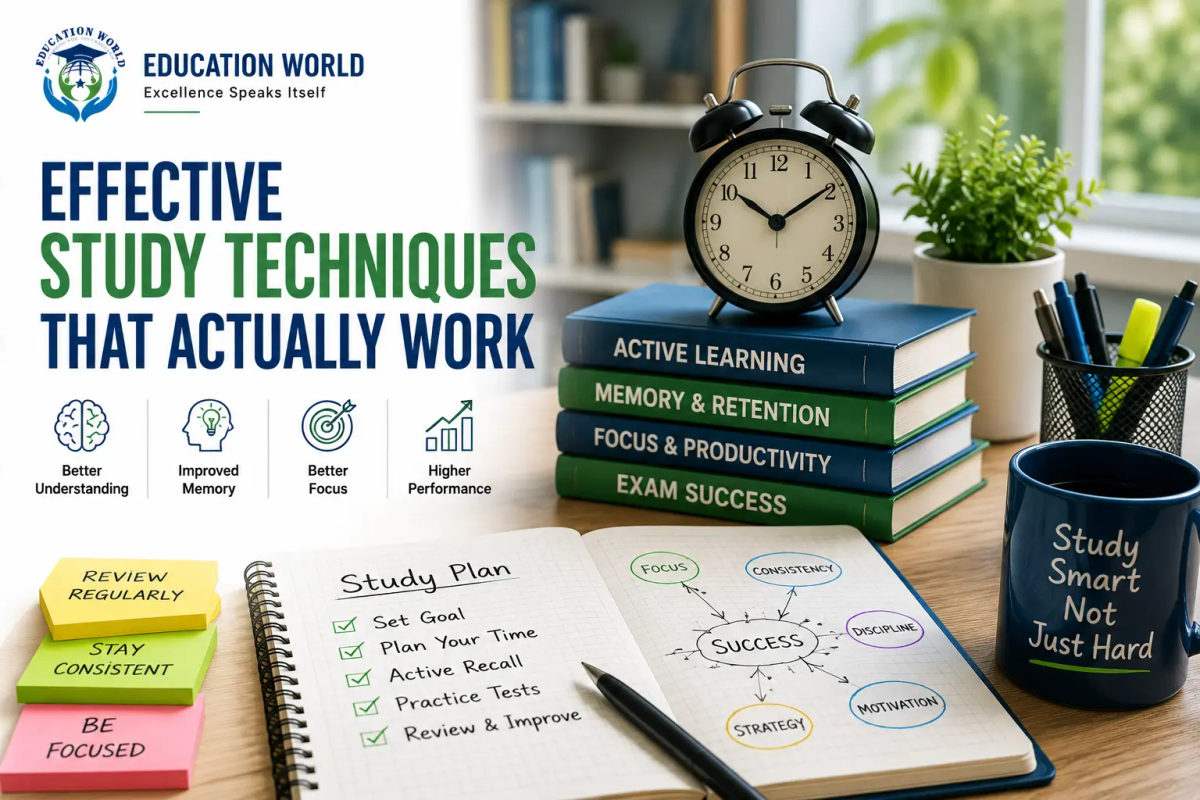
Many students believe that studying longer automatically leads to better grades. In reality, the effectiveness of your study methods matters far more than the number of hours you spend with your books open.
Research in learning science consistently shows that certain study techniques significantly improve understanding, memory retention, and academic performance. Unfortunately, many students continue using ineffective methods simply because they seem familiar or comfortable.
This guide explores practical study techniques that actually work and can help students learn more efficiently.
Many learners rely on methods such as:
Re-reading textbooks repeatedly
Highlighting entire pages
Memorizing without understanding
Passive note review
While these activities may feel productive, they often provide limited long-term learning benefits.
The key to effective studying is active engagement with information.
Active recall involves retrieving information from memory without looking at notes.
Instead of reading a chapter repeatedly, ask yourself questions about the material and attempt to answer them from memory.
Examples include:
Self-quizzing
Practice questions
Flashcards
Teaching concepts from memory
Every time you retrieve information, you strengthen the memory pathway, making future recall easier.
Spaced repetition involves reviewing information over increasing intervals of time.
Instead of cramming everything into one session, review material:
After one day
After three days
After one week
After two weeks
After one month
Improves long-term retention
Reduces forgetting
Makes revision more efficient
This technique is widely used by top-performing students and language learners.
Named after physicist Richard Feynman, this method focuses on explaining concepts in simple language.
Choose a topic.
Explain it as if teaching a beginner.
Identify gaps in understanding.
Review weak areas.
Simplify again.
If you cannot explain a concept simply, you probably do not understand it fully.
Testing yourself is one of the most effective learning strategies available.
Examples include:
Past exam papers
Mock exams
Practice quizzes
Sample questions
Practice testing:
Identifies knowledge gaps
Builds confidence
Improves recall speed
Prepares students for real exam conditions
Most students study one topic for hours before moving to another.
Interleaving takes a different approach.
Instead of:
Topic A → Topic A → Topic A
Try:
Topic A → Topic B → Topic C → Topic A
Interleaving improves:
Problem-solving ability
Concept recognition
Long-term understanding
This method is particularly effective in mathematics, science, and technical subjects.
Consistency is more effective than occasional intense study sessions.
Schedule:
Study sessions
Revision periods
Breaks
Practice tests
A realistic schedule helps reduce stress and prevents last-minute cramming.
The Pomodoro Technique improves concentration by dividing study time into focused intervals.
25 minutes focused work
5-minute break
After four cycles:
Take a longer break
This method helps maintain mental energy and reduces burnout.
Your surroundings directly influence concentration.
Reduce:
Social media distractions
Unnecessary notifications
Background noise
A clean environment improves focus and productivity.
Good notes should help you understand information rather than simply copy it.
Summarize:
Definitions
Concepts
Examples
Relationships between topics
Consider:
Mind maps
Flowcharts
Diagrams
Tables
Visual learning can improve comprehension.
Many students sacrifice sleep to study longer.
This is a mistake.
Sleep is essential for:
Memory consolidation
Learning
Focus
Problem-solving
Students who sleep adequately often perform better than those who study all night.
Exercise benefits academic performance by:
Improving concentration
Reducing stress
Enhancing memory
Boosting energy levels
Even short daily walks can improve cognitive function.
Short-term memorization often disappears quickly after exams.
Studying while checking social media reduces focus and learning quality.
Reading without active engagement creates an illusion of learning.
Students often spend too much time reviewing topics they already know.
Focus on improving weaker subjects.
Motivation fluctuates, but systems create consistency.
Try:
Setting clear goals
Tracking progress
Celebrating small achievements
Studying with purpose
Discipline often produces better results than waiting for motivation.
Effective studying is not about spending more time at your desk. It is about using proven learning strategies that maximize understanding and retention.
Techniques such as active recall, spaced repetition, practice testing, and the Feynman Technique can dramatically improve academic performance while reducing wasted effort.
By studying smarter rather than harder, students can achieve better results, reduce stress, and develop lifelong learning skills that extend far beyond the classroom.
Comments
Ask a question or share helpful information. Comments are reviewed by our team before they appear.
No comments yet - be the first to ask a question about this post.