
Admissions4 min read


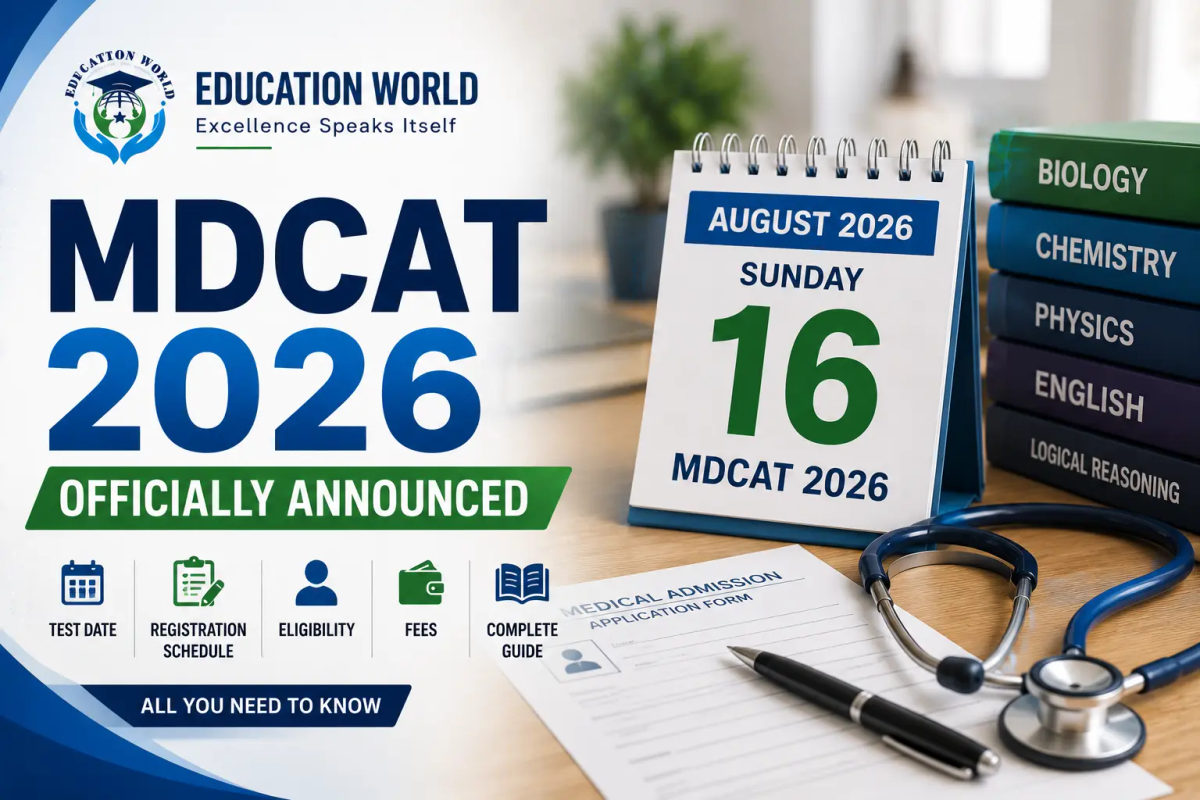
Students planning to pursue MBBS or BDS in Pakistan can now officially begin preparing for MDCAT 2026, as the Pakistan Medical and Dental Council (PMDC) has announced the complete examination schedule.
The Medical and Dental College Admission Test (MDCAT) remains the mandatory entrance examination for admission into medical and dental colleges across Pakistan.
This year, PMDC has confirmed the MDCAT 2026 exam date, registration timeline, fee structure, eligibility requirements, and examination pattern.
Here's everything students need to know.
PMDC has officially announced that MDCAT 2026 will be held on:
Sunday, 16 August 2026
Exam Time: 10:00 AM (Pakistan Standard Time)
Students across Pakistan will appear in the examination on the same day according to PMDC's official schedule.
University Selection, Higher Education, Pakistani Universities, Admissions Guide, Student Career Planning, University Ranking, Education World Pakistan, Undergraduate Admissions, Student Success, Degree Programs

Students should complete their registration as early as possible to avoid last-minute issues.
Registration Opens: 22 June 2026
Regular Registration Deadline: 8 July 2026
Late Registration Deadline: 13 July 2026
Admit Cards Expected: Early August 2026
MDCAT Examination: 16 August 2026
Thousands of students register close to the deadline every year. Applying early can help you avoid technical issues and unnecessary stress.
MDCAT stands for the Medical and Dental College Admission Test.
It is Pakistan's national entrance examination required for admission into:
MBBS programs
BDS programs
Public medical colleges
Private medical colleges
Without a valid MDCAT score, students cannot secure admission to medical or dental colleges in Pakistan.
Every year, approximately 200,000 students compete for a limited number of medical seats.
Regular Registration Fee: PKR 9,000
Late Registration Fee: PKR 13,000
Regular Registration Fee: PKR 45,000
Late Registration Fee: PKR 55,000
Important: All fees are non-refundable and non-transferable.
Students must meet the following requirements.
Minimum 60% marks in FSc Pre-Medical or equivalent qualification
Biology and Chemistry are compulsory subjects
Physics or Mathematics is required as the third science subject
Valid CNIC or B-Form
Domicile Certificate
Juvenile Registration Certificate (JRC) for candidates under 18 years of age
IBCC Equivalence Certificate for O-Level, A-Level, or foreign qualification holders
PMDC has confirmed:
No age limit
No attempt limit
Students may appear in MDCAT multiple times if needed.
PMDC has officially confirmed that there is no age limit and no attempt limit for MDCAT 2026. Candidates can appear in the exam multiple times if needed.
Before registration begins, prepare the following documents:
CNIC or B-Form
Recent passport-sized photograph
Matric certificate and marks sheet
FSc certificate and marks sheet
Domicile certificate
JRC (for candidates under 18 years old)
IBCC Equivalence Certificate (if applicable)
Having these documents ready beforehand can help avoid registration delays.
PMDC has retained the same examination format.
Total Questions: 180 MCQs
Duration: 3 Hours
Test Format: Paper-Based
Answer Method: OMR Sheet
Negative Marking: No
Correct Answer = 1 Mark
Incorrect Answer = 0 Marks
No Negative Marking
The MDCAT paper consists of 180 MCQs distributed across five subjects:
Biology: 81 MCQs (45%)
Chemistry: 45 MCQs (25%)
Physics: 36 MCQs (20%)
English: 9 MCQs (5%)
Logical Reasoning: 9 MCQs (5%)
Biology remains the most important subject in terms of weightage.
Students must score at least:
55% (99 out of 180 MCQs)
Students must score at least:
50% (90 out of 180 MCQs)
Keep in mind that meeting the passing criteria does not guarantee admission, as final merit depends on competition and available seats.
Total of 180 MCQs
PMDC has confirmed that there are no major syllabus changes for MDCAT 2026.
Students should continue preparing the following subjects:
Biology
Chemistry
Physics
English
Logical Reasoning
Those who have already started preparation can continue without worrying about major syllabus revisions.
Many students lose valuable marks because of avoidable mistakes.
Delaying preparation often creates unnecessary pressure close to the examination.
Biology carries 45% of the entire paper and should receive significant attention.
MDCAT is a competitive MCQ-based examination. Regular practice is essential.
Mock tests help improve:
Time management
Accuracy
Speed
Confidence
Understanding concepts is becoming increasingly important in modern MDCAT examinations.
To maximize your chances of success:
Create a realistic study timetable
Divide time between all five subjects
Focus on weaker topics
Practice MCQs regularly
Attempt full-length mock tests
Revise consistently
Small daily improvements often produce better results than last-minute preparation.
MDCAT 2026 is officially scheduled for 16 August 2026, giving students a clear timeline for preparation.
With registration opening on 22 June 2026 and regular registration closing on 8 July 2026, candidates should complete their applications early and avoid waiting until the final days.
Students who remain consistent, practice regularly, and prepare strategically will place themselves in the strongest position for success.
Stay connected with Education World for the latest MDCAT updates, admissions news, scholarships, results, and educational opportunities across Pakistan.
.webp?tr=w-480%2Cq-78%2Cf-auto)
Comments
Ask a question or share helpful information. Comments are reviewed by our team before they appear.
No comments yet - be the first to ask a question about this post.