

Student Success4 min read
Why Critical Thinking Is Becoming the Most Important Skill for Students


Modern students have access to more information than any generation before them. With a few clicks, they can find articles, videos, tutorials, research papers, and AI-generated answers on almost any topic.
However, access to information is no longer the biggest challenge.
The real challenge is knowing what information to trust, how to analyze it, and how to use it effectively.
This is where critical thinking becomes essential.
Critical thinking is often described as one of the most valuable skills in education and the workplace because it helps individuals evaluate information, solve problems, make informed decisions, and think independently.
As technology continues to evolve, the importance of critical thinking will only increase.
Critical thinking is the ability to analyze information objectively and make reasoned judgments.
It involves:
Evaluating evidence
Asking thoughtful questions
Identifying assumptions
Considering multiple perspectives
Solving problems logically
Making informed decisions
Rather than accepting information at face value, critical thinkers investigate and evaluate before forming conclusions.
We live in an era of information overload.
Every day, students encounter:
Social media content
News articles
Online videos
AI-generated information
Advertisements
Opinions presented as facts
Not all information is accurate.
Critical thinking helps students separate reliable information from misinformation.
Students who develop critical thinking skills often perform better academically.
Instead of memorizing information, they learn how to:
Understand concepts deeply
Analyze complex topics
Connect ideas together
Evaluate arguments
Apply knowledge in new situations
These abilities are valuable across all subjects.
Most real-world challenges do not have simple answers.
Critical thinking helps students:
Identify problems clearly
Evaluate possible solutions
Compare alternatives
Predict outcomes
Make better decisions
Strong problem-solving abilities are highly valued in both education and employment.
Employers increasingly seek candidates who can think independently.
Organizations want people who can:
Analyze situations
Make decisions
Solve unexpected problems
Adapt to change
Improve processes
Many industry reports consistently rank critical thinking among the most important workplace skills.
Artificial Intelligence is transforming education and work.
While AI can generate information quickly, it cannot replace human judgment.
Students must still decide:
Whether information is accurate
Which sources are trustworthy
What conclusions are reasonable
How information should be applied
The students who benefit most from AI will not be those who blindly accept AI-generated answers.
They will be those who use critical thinking to verify information, ask better questions, and make smarter decisions.
AI and critical thinking work best together.
Students with strong critical thinking skills often:
Ask thoughtful questions
Seek evidence before believing claims
Consider multiple viewpoints
Remain open-minded
Recognize biases
Think logically
Learn from mistakes
These habits contribute to both academic and personal growth.
Many people trust information simply because it appears online.
Strong emotions can sometimes interfere with objective analysis.
People often seek information that supports their existing beliefs.
Some students hesitate to challenge ideas or ask questions.
Recognizing these barriers is the first step toward overcoming them.
Instead of accepting information immediately, ask:
Is this accurate?
What evidence supports this claim?
Are there alternative explanations?
Comparing different perspectives provides a broader understanding of complex topics.
Meaningful discussions encourage analysis and reflection.
Puzzles, case studies, research projects, and real-world challenges help strengthen critical thinking.
Reviewing past decisions can reveal valuable lessons and improve future judgment.
The answer is simple: everyone.
Whether a student plans to pursue:
Medicine
Engineering
Business
Education
Law
Technology
Social Sciences
critical thinking remains essential.
It is a skill that supports success across all professions and industries.
Future careers will increasingly require:
Adaptability
Innovation
Decision-making
Problem-solving
Information evaluation
As automation handles routine tasks, human thinking skills will become even more valuable.
Students who develop these abilities today will be better prepared for tomorrow's challenges.
Critical thinking is no longer just an academic skill—it is a life skill.
In a world where information is abundant and technology is advancing rapidly, the ability to think independently, evaluate evidence, and make informed decisions has become more important than ever.
Students who develop strong critical thinking habits will not only perform better academically but will also be better equipped to navigate future careers, solve complex problems, and make confident decisions throughout their lives.
The future belongs to those who can think, question, analyze, and adapt.
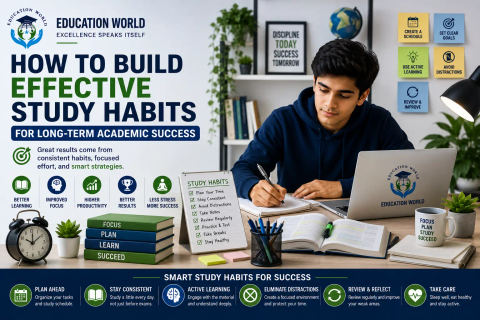
Successful students are not born with perfect study skills—they develop effective habits over time. Learn practical strategies that improve learning, retention, productivity, and long-term academic performance.

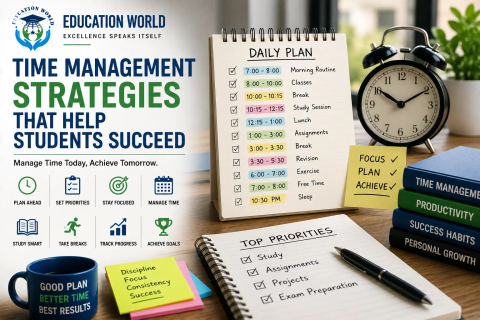
Effective time management helps students reduce stress, improve productivity, and achieve academic goals. Learn practical strategies to manage your schedule, stay organized, and make the most of every day.
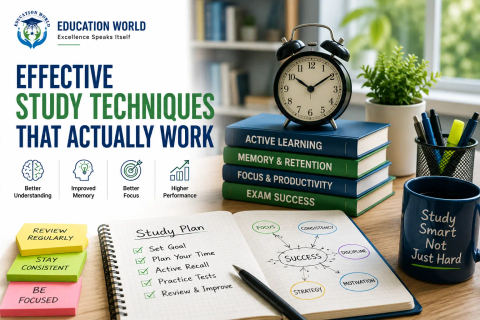
Studying for hours does not always lead to better results. Discover evidence-based study techniques that improve understanding, retention, concentration, and exam performance while helping students learn more efficiently and effectively.
Comments
Ask a question or share helpful information. Comments are reviewed by our team before they appear.
No comments yet - be the first to ask a question about this post.